

The question
Russell did lose around 0.2 s on the final straight after T15. However, the wider lap comparison does not support a simple, lap-wide straight-line-speed problem: his speed on the Kemmel Straight was almost identical to Antonelli's, and the available telemetry cannot show whether the late deficit came from energy deployment or an issue with the car.
Welcome to my first-ever post. They can only get better from here!
In this article, I wanted to take a look at the qualifying lap differences between Russell and Antonelli at the Belgian GP. After qualifying, Russell said that he had lost four tenths on the straights in Q3 [2]. Toto Wolff said that Mercedes could not explain a couple of tenths of Russell's straight-line deficit [3]. Russell also said that Mercedes had investigated driving style and technique, but changing his approach at Spa did not close the gap [2].
So I thought that'd be a great question to test.
The data
I don't think I'll include these caveats at the start of every blog post. They'll go in the About section. But this is my first blog post, so they go in this one!
I'm using the FastF1 data library to do this analysis, which provides all telemetry made publicly available during live timing sessions. Unfortunately, this doesn't include:
- Battery deployment or level
- Recharge information
- Steering angle
This analysis compares each driver's fastest Q3 lap: Antonelli's 1:44.361 pole lap and Russell's 1:44.869, a gap of 0.508 s [1]. It does not control for tow, track evolution, tyre preparation, setup differences or the battery state at the start of each lap.
The sampling is done about every 0.2 s. Generally, if you spot something strange (e.g., a sudden short loss of speed), it can be explained as a telemetry glitch. I'll go into this more at some point.
I'll write another blog post soon and see if we can create some sort of proxy for how much deployment is happening based on acceleration.
With that said, let's dive in and see what we can suss out.
Raw sector times
Sector 1 was effectively equal between the two drivers, with the main difference appearing in S3:
- Russell gained 0.024 s in S1.
- Antonelli gained:
- 0.165 s in S2.
- 0.367 s in S3.
This S3 gap is probably why Russell says things like "There were four tenths on the straights in Q3". But I think it's not as simple as he makes it out to be. Let's start by looking at the relative apex speeds:
Apex speeds
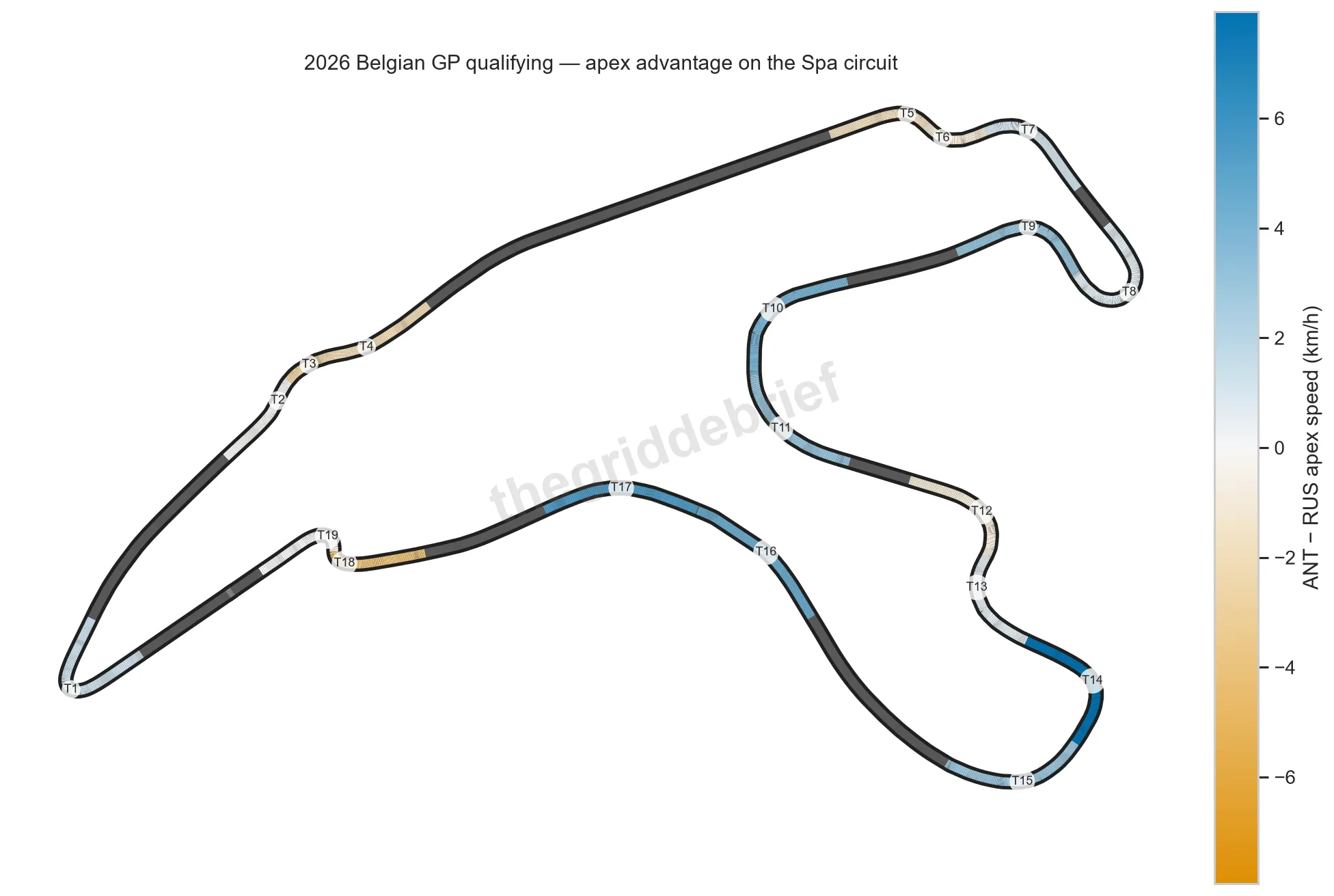
The charts show:
The early part of the lap is mixed:
- Russell faster at the T3/T4 and T5/T6 apexes.
- T2, T8, T12 and T13 are effectively tied within 1 km/h tolerance.
Antonelli becomes stronger across the middle and final parts of the lap:
- T9: +3.0 km/h.
- T10: +3.9 km/h.
- T11: +3.0 km/h.
The clearest sequence is T14-T17:
- T14: +7.9 km/h.
- T15: +2.8 km/h.
- T16: +4.4 km/h.
- T17: +5.3 km/h.
Apex speed itself does not indicate smoothness, but Antonelli is clearly gaining time in the corners through S2 and S3.

Let's avoid drawing too many conclusions at this point and move on to looking at Sector 3 in more detail.
Turn 12 onwards
Turns 12-17 cover the fast chicane of Les Fagnes. Campus is then the last corner with any real braking before the flat-out run through Stavelot and Blanchimont.
The throttle/brake trace shows Russell braking slightly later for T12, but Antonelli gets on the power earlier and gets his time back through T13. He carries more speed through T14 and gets on the power earlier. Finally, at Stavelot, both drivers seem to have very similar apex speeds.
But then, around 200 m after T15, Antonelli appears to gain up to 5 km/h or more on Russell through Blanchimont and towards the chicane. This is clearer when plotting the relative speed between Antonelli and Russell from T15 onwards:
I've included in this plot the relative speeds over the Kemmel straight, which are almost identical between the drivers, with Antonelli maybe having a slight advantage.
It's almost certain that the cars will be set up slightly differently. If the drivers were identical, you'd think that a car set up for faster cornering would lose time on the straights. This year in particular, if you need to use more battery to keep speed up in the corners, there will be pain to come on the straights.
But here, Antonelli is able both to corner faster through S3 and to gain time on the straight. Potentially, we're reaching a conclusion where Russell is right to feel aggrieved.
I'll include one last plot:
All of the time gained by Antonelli over the lap comes from about halfway through the lap, when the fast corners begin. In fact, only 0.2 s is gained from around T15 to the end of the lap.
Throttle analysis
I have plans to do a more in-depth analysis on the 2026 cars soon. In particular, I want to see if we can look at the acceleration over a lap and find some proxy measure for deployment modes.
However, for this lap, I calculated a throttle-weighted distance for each driver by integrating throttle position over lap distance. The lower panel therefore shows accumulated throttle distance, not time spent on the throttle or electrical energy deployed. The idea was to test whether Russell accumulated more throttle application across the lap, which could help form a hypothesis about his later speed loss.
Interestingly, Russell uses more throttle around T5, T6 and T7. Then, from T9 to T14, he uses slightly more full throttle than Antonelli despite being slower in this section.
Full throttle is not a proxy for electrical deployment. Deployment also depends on control strategy, state of charge and channels that are not available in FastF1. This plot can therefore only motivate a hypothesis: Russell may have used more deployment in these corners and then had less available on the later straight. The telemetry here cannot confirm that explanation.
Conclusions
Russell said after qualifying at Spa that Mercedes had suspected driving style after Silverstone, but that changing his technique at Spa did not resolve the issue [2]. Subsequent reporting said Mercedes identified a power-unit software calibration problem affecting deployment [4].
Mercedes has access to battery state, deployment and calibration channels that are absent from FastF1, so its later diagnosis should carry more weight than any inference from public telemetry.
Regardless, we've looked at the data from the lap and can see:
- Antonelli has a pace advantage through all the corners from T8 (Rivage) onwards and is faster at every apex apart from the chicane.
- The drivers' speeds on the Kemmel Straight are almost identical.
- There is a specific pace deficit of around 0.2 s on the final straight from T15 to the chicane.
Taken on its own, the public telemetry supports a specific late-lap straight-line deficit, not a general lack of straight-line speed around the whole lap. It shows where the loss emerged, but not whether it was caused by energy deployment, setup or a car-specific fault.
At the time of qualifying, the data left two plausible hypotheses:
- The way Antonelli carried speed through the corners may have left him with more battery to deploy on the final straight.
- Russell may have had a car or calibration issue that caused the loss through both the corners and the final straight.
Mercedes' later diagnosis supports the second hypothesis, but that conclusion came from private data that is unavailable in this analysis [4].
Come back in a few days when I've had a chance to look at the deployment analysis and whether we can do more there!
References
- FIA (2026), Antonelli claims Belgian Grand Prix pole after dramatic Spa qualifying.
- GrandPrix247 (2026), George Russell baffled after Kimi Antonelli 'destroyed' him in Belgian Grand Prix qualifying.
- Formula 1 (2026), Wolff gives reason for Russell's Belgian Grand Prix qualifying deficit to Antonelli.
- Autosport (2026), Russell: data shows software calibration behind recent F1 struggles, not driving style.